PqMold is your trusted one-stop custom manufacturing solution, from prototype design to manufacturing, through huge manufacturing resources, suitable technology, streamlined process, expert guidance, and perfect quality inspection process to turn your ideas into reality.
From PqMold, get fast and reliable manufacturing solutions with online quoting and free design analysis completed within hours. Our experienced engineering team reviews your design to optimize manufacturability, quality, and cost—so your CNC machined prototypes and production parts are delivered in just days, not weeks.
With advanced production equipment and an experienced team of engineers, we can manufacture products with complex geometric shapes and high-precision requirements under strict tolerance control and comprehensive quality inspection processes.
From material selection to final inspection and reliable product quality.
PqMold meets mass production needs through strict tolerance control, comprehensive quality inspection, and a complete supply chain, delivering cost-effective, high-precision parts quickly and reliably.
With scalable manufacturing capabilities and consistent performance from pilot runs to full-scale production.
State-of-the-art Equipment
10+ Years of CNC Machining
Competitive & Affordable Price
Quote Within 24 hours
Free DFM Feedback
Fast Turnaround in 7 days
Competitive & Affordable Price
State-of-the-art Equipment
10+ Years of Low-Volume Manufacturing
Fast Lead Time
30+ Countries shipped
100% Part Inspection
10+ Years of Medium&Mass Production
Competitive & Affordable Price
Large Supplier Network
100,0000+ Unique parts produced
Guaranteed Consistent Quality
Fast Turn-Around Production
Sand Casting Services
Why Choose Us for Custom Sand Casting Services
PqMold provides full-service custom sand casting, including metal pouring, various molding techniques, and in-house patternmaking to create prototype and production castings. Using our sand-casting services takes your company to new heights of success.
We are dedicated to producing superior custom sand castings that either match or surpass the expectations of our clients. We have put in place a strong quality control procedure that guarantees each casting is carefully examined for flaws.
Our staff comprises seasoned engineers and technicians with vast knowledge and proficiency in the process of custom sand casting. We may offer advice on design optimization, material selection, and other casting-related topics.
We provide a variety of customization choices to satisfy the unique requirements of our clients. To generate one-of-a-kind and intricate designs, we may make custom molds and provide a variety of casting alternatives.
We provide affordable prices without sacrificing quality. We collaborate with our clients to comprehend their spending plans and provide affordable solutions that satisfy their requirements.
04
Sand Casting Services
Work with Us in 4 Simple Steps Only
With many years of manufacturing experience, PqMold offers the best solutions for all rapid prototyping and low-volume manufacturing needs. We streamline the innovation cycle into four simple but effective steps.
01
Upload Your Design
Just simply upload your CAD files and submit RFQs with clear information online.
02
Receive Design Analysis
We'll send you design for manufacturability analysis and transparent pricing.
03
Start Manufacturing
Our experts will produce your parts with the required technologies and materials.
04
Receive Your Parts
Your parts will be delivered to your door directly with stringent deadlines.
Sand Casting Services
Sand Casting Tolerances and Standards
Sand casting does not deliver tighter tolerances than other casting processes, but in most cases, the industry standards can meet the product requirements. Please note that PqMold is capable of casting better tolerances than these standards.
Standard
Capabilities
Casting Size (mm)
10-1000
Maximum Casting Weight (kg)
10
Minimum Wall Thickness (mm)
0.5
Tolerance (mm)
0.02
Surface Finish
Ra1.6
Tolerance
CT4-CT7
MOQ
500
Additional Services
CNC machining, Powder coating, Anodizing, Assembly, Packaging, etc.
Sand Casting Services
Materials for Custom Sand Casting Parts
Sand casting is a common manufacturing technique for producing metal parts and components in various sectors. The needs of the application determine which material is best for sand casting. Here are some common sand casting materials:
ADC12
ADC12 is an Al-Si-Cu alloy, a die-cast aluminum alloy. Applying for automotive, motorcycle, electronic products, lighting, home decorations, etc..
Stainless steel 304 is widely used in the manufacture of various parts and structural parts due to its excellent corrosion resistance and wear resistance. Applying for medical equipment, electronic components, architectural decorations, etc.
Stainless steel 304 is widely used in the manufacture of various parts and structural parts due to its excellent corrosion resistance and wear resistance. Applying for medical equipment, electronic components, architectural decorations, etc.
PqMold can help improve the surface qualities of your products by offering a diverse range of surface finishes. Surface finishes on your customized parts aim to improve their appearance, surface hardness, and roughness, chemical and corrosion resistance, and so on. Here are some of your best options.
Anodizing
Anodizing improves corrosion resistance, enhancing wear resistance and hardness, and protecting the metal surface. Widely used in mechanical parts, aircraft, and automobile parts, precision instruments, etc.
Powder coating is a type of coating that is applied as a free-flowing, dry powder. Unlike conventional liquid paint which is delivered via an evaporating solvent, powder coating is typically applied electrostatically and then cured under heat or with ultraviolet light.
Electroplating can be functional, decorative or corrosion-related. Many industries use the process, including the automotive sector, in which chrome-plating of steel automobile parts is common.
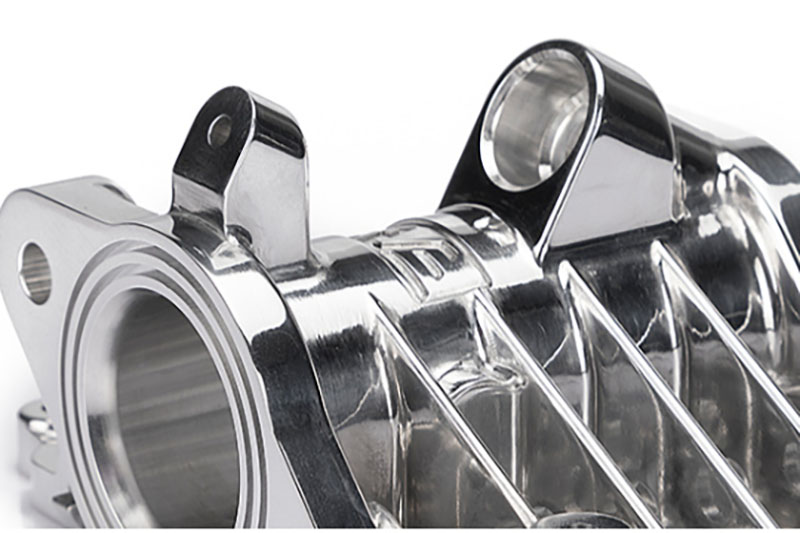
Polishing is the process of creating a smooth and shiny surface, either through physical rubbing of the part or by chemical interference. The process produces a surface with significant specular reflection, but in some materials is able to reduce diffuse reflection.
Anodizing improves corrosion resistance, enhancing wear resistance and hardness, and protecting the metal surface. Widely used in mechanical parts, aircraft, and automobile parts, precision instruments, etc.
Powder coating is a type of coating that is applied as a free-flowing, dry powder. Unlike conventional liquid paint which is delivered via an evaporating solvent, powder coating is typically applied electrostatically and then cured under heat or with ultraviolet light.
Electroplating can be functional, decorative or corrosion-related. Many industries use the process, including the automotive sector, in which chrome-plating of steel automobile parts is common.
Polishing is the process of creating a smooth and shiny surface, either through physical rubbing of the part or by chemical interference. The process produces a surface with significant specular reflection, but in some materials is able to reduce diffuse reflection.
PqMold’s staff takes your order needs, from quotation to finished parts, as our machines and efficient team ensure you receive your tooling and parts within scheduled lead times. The workflow usually looks like this:
01
Request Instant Quote
From the moment we receive your inquiry email, our professional engineers will provide a response within 24 hours to ensure a smooth process.
02
Engineer Evaluation
To ensure we can produce functional molds, we conduct a feasibility review of your design to ensure we can meet the requirements before commencing production.
03
Mold Flow Analysis
Predictive modeling software helps us understand how the molten material moves and acts within the mold, which helps us make improvements.
04
Mold Tooling Production
Using your preferred materials enables us to make mold tooling that is of high quality and can readily fit your applications.
05
Sample Inspection
Sampling will be delivered for you to review prior to manufacturing plastic parts to ensure precision and quality.
06
Low Volume Production
After the trial production phase, we begin batch production, which uses powerful machining to manufacture parts at fast rates to save on time and costs.
Sand Casting FAQs
Explore frequently asked questions about sand casting processes, including material selection, tooling patterns, dimensional tolerances, surface finishes, and ideal production volumes. Discover how PQMold manages quality control and cost efficiency to deliver reliable sand cast components for industrial applications.
01. What is Sand Casting?
Sand casting is a process where molten metal is cast in a mold made from a sand mixture. Previously, the method was only economical for small-scale manufacturing. However, because of automated machinery for creating sand molds, it can now also be used for high-volume manufacture.
02.What sand is used for casting?
Silica sand is the most commonly used sand because of its great abundance, and, thus, low cost (therein being its greatest advantage). Its disadvantages are high thermal expansion, which can cause casting defects with high melting point metals, and low thermal conductivity, which can lead to unsound casting.
03.What are the advantages and disadvantages of sand casting?
The advantage is low cost in small volumes. Not limited by size. Easy to change part design. The disadvantage is high cost in large production runs. Parts are less complex. Lower dimensional accuracy. Surface finish requires additional work.
04.What is the difference between casting and sand casting?
Die casting involves using high pressure to inject molten metal into a metal mold, and sand casting involves pouring molten metal into a sand mold. Die casting and sand casting are both reliable processes, but each has its pros and cons.
05.Is sand casting strong?
There’s a wide range of materials that can be used in CNC machining – you can use such as aluminum, steel, brass, copper, titanium, as well as rigid plastics. Reach out to learn more about the types of materials that could be used.
06.Is sand casting the same as forging?
Casting is the process in which metal is heated in a furnace until molten. While in the liquid state, the metal is poured into a die, or mold, to create a component shape. Forging is the process in which thermal and mechanical energy is applied to ingots to cause the alloy to change shape while in a solid state.
Contact
Have a Project in Mind?
Contact With Us
If you have a project in mind, our team is ready to guide you from concept to completion with expert support and reliable engineering solutions. Reach out to us and let’s build it together.