Welcome Professional Custom Parts Machining and Mold Service Provider
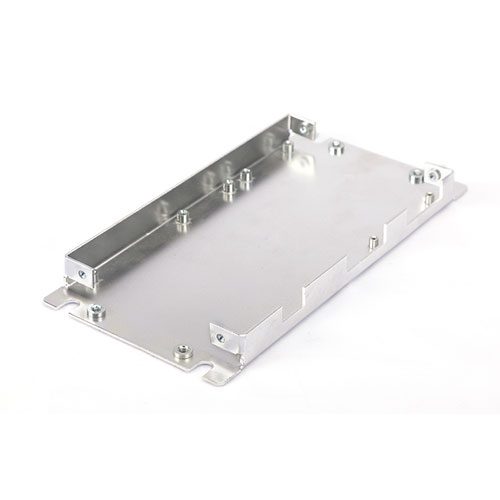
Each sheet metal riveting process is selected based on the application and accessibility of the material. PqMold customizes sheet metal riveting solutions at competitive prices. Our professional sheet metal riveting technology ensures efficient, precise, and consistent riveting, guaranteeing the excellent quality of each project.
PqMold is your trusted one-stop custom manufacturing solution, from prototype design to manufacturing, through huge manufacturing resources, suitable technology, streamlined process, expert guidance, and perfect quality inspection process to turn your ideas into reality.
PqMold’s complete production line provides sheet metal riveting services covering all manufacturing processes required for new project development, including secondary finishing, custom packaging, and final product assembly. With advanced manufacturing skills and technical expertise, our engineers are committed to reducing cycle times by up to 50%.
With many years of manufacturing experience, PqMold offers the best solutions for all rapid prototyping and low-volume manufacturing needs. We streamline the innovation cycle into four simple but effective steps.
Just simply upload your CAD files and submit RFQs with clear information online.
We'll send you design for manufacturability analysis and transparent pricing.
Our experts will produce your parts with the required technologies and materials.
Your parts will be delivered to your door directly with stringent deadlines.
Rivets are widely used in sheet metal assembly for their simplicity, strength, and reliability. Depending on project requirements, different rivet types are selected for secure, long-lasting connections. This includes applications with thin metals, hollow parts, or smooth finishes.
Here are some commonly used rivet types for reference:
| Type of Rivet | Image | Description | Applications |
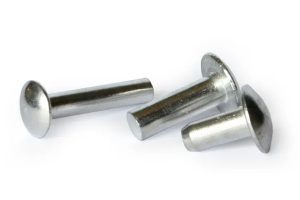
| Solid Rivets | ![]() | Be durable and easy to install. Come in various materials, colors, and sizes. Achieve strong, permanent joints in sheet metals. | Used in assembling sheet metals. |
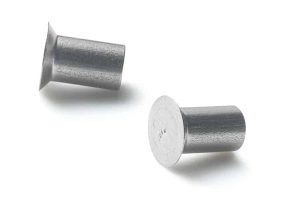
| Tubular Rivets | ![]() | Be hollow and strong. Available in two types: Full Tubular and Semi-tubular. Full tubular rivets punch holes; semi-tubular rivets reduce force during assembly. | Suitable for aluminum and thin metals. Full tubular rivets for punching holes, semi-tubular for light applications like electronics, HVAC, and brakes. |
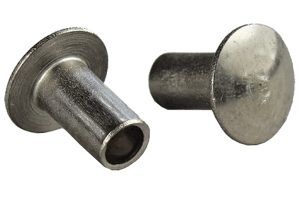
| Blind Rivets | ![]() | Used when one side of a surface is inaccessible. Ideal for hollow parts. | Used when one side of the surface cannot be accessed (e.g., hollow parts) |
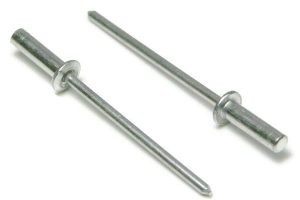
| Flush Rivets | ![]() | Use countersunk holes and heads for a smooth, aesthetically pleasing finish. | Commonly used in aircraft to maintain smooth airflow. |
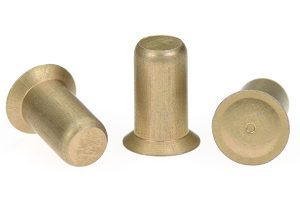
| Split Rivets | ![]() | Have two legs at the bottom, folded back after installation | Used in applications like bicycle seats, leather, fabrics, and tin plates. |
| Self-Piercing Rivets | ![]() | Require no drilling. Use a bevel drill to form a button-like element during assembly. | Used for assembly without pre-drilled holes. |
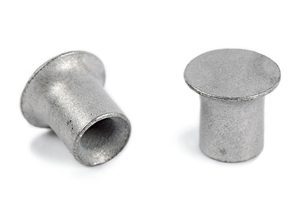
| Friction Lock Rivets | ![]() | suitable for demanding applications. | Commonly use |
In sheet metal riveting, selecting the right material is crucial to ensure the durability and strength of the riveted joints. Here are some of the most commonly used materials for sheet metal riveting:
Lightweight and Corrosion-Resistant: Aluminum is widely used in aerospace, automotive, and electronics industries due to its light weight and resistance to corrosion. It’s ideal for applications where reducing weight is critical.
Lightweight and High Strength: Titanium is used in specialized applications, particularly in aerospace and medical devices, due to its exceptional strength-to-weight ratio and corrosion resistance, though it’s more expensive.
Corrosion-Resistant and Aesthetic Appeal: Brass offers good corrosion resistance and is often chosen for decorative applications or where a high-quality finish is needed. It is commonly used in the manufacturing of fittings, instruments, and small enclosures.
Corrosion-Resistant and Durable: Stainless steel is used in applications requiring high strength and corrosion resistance, such as in the food, chemical, and medical industries. Its durability makes it suitable for harsh environments.
Lightweight and Corrosion-Resistant: Aluminum is widely used in aerospace, automotive, and electronics industries due to its light weight and resistance to corrosion. It’s ideal for applications where reducing weight is critical.
Lightweight and High Strength: Titanium is used in specialized applications, particularly in aerospace and medical devices, due to its exceptional strength-to-weight ratio and corrosion resistance, though it’s more expensive.
Corrosion-Resistant and Aesthetic Appeal: Brass offers good corrosion resistance and is often chosen for decorative applications or where a high-quality finish is needed. It is commonly used in the manufacturing of fittings, instruments, and small enclosures.
Corrosion-Resistant and Durable: Stainless steel is used in applications requiring high strength and corrosion resistance, such as in the food, chemical, and medical industries. Its durability makes it suitable for harsh environments.
Check out our over a decade of custom sheet metal riveting parts, including precision machined prototypes and parts from our valued customers.
Explore key information about sheet metal riveting processes, joint strength, material compatibility, and fastening methods.
Sheet metal riveting is ideal for heat-sensitive materials, flexibility, and disassembly, especially with lightweight or thin materials. Welding is better for strong, permanent joints, especially in load-bearing applications. Consider strength, material type, and heat tolerance when deciding.
Environmental factors like corrosion, temperature fluctuations, and vibrations can weaken riveted joints. Using the right materials, coatings, and rivet types helps prevent damage. This ensures durability and reliability in harsh conditions, allowing joints to last longer and stay strong.
Automated sheet metal riveting systems increase speed, accuracy, and consistency in large-scale production. They reduce labor costs, improve safety, and offer flexibility with rivet sizes. This boosts efficiency while ensuring high-quality, reliable results in high-volume production.
When riveting sheet metal, consider material compatibility, choosing the right rivet type and size, hole preparation, tooling, and environmental factors like temperature and moisture. Sequencing steps correctly ensures smooth assembly and strong, durable joints.
Material selection affects riveted joints’ performance and lifespan. Strong, corrosion-resistant materials like stainless steel or aluminum improve durability. Matching rivet and base materials maximizes strength, while considering thermal expansion and environmental conditions ensures longer-lasting joints.
At PqMold, we meet complex customer needs through close communication and a streamlined process. We ensure real-time synchronization across design, prototyping, and production. With a flexible, fully equipped production line, we ensure precision and quality in every project, regardless of complexity.
Sheet metal riveting is a process that joins two or more sheet metal pieces by inserting a rivet through aligned holes and deforming its ends to create a strong, permanent bond. Sheet metal riveting is widely used in industries where high-strength, permanent joints are needed but welding is impractical.By combining our expertise with a customer-centric approach, PqMold ensures every joint is strong, precise, and durable. Our commitment to quality, speed, and cost-efficiency makes us your ideal partner.
Sheet metal riveting is generally not expensive, especially for high-volume or standard applications. However, costs can vary based on the materials, equipment, and labor involved.
The dimensions of sheet metal rivets typically include the diameter and length of the rivet shank and the size and shape of the rivet head, which vary depending on the application and material thickness.
To rivet metal plates, align them, drill matching holes, insert a rivet through them, and use a rivet gun or hammer to secure the rivet by deforming its tail end.
If you have a project in mind, our team is ready to guide you from concept to completion with expert support and reliable engineering solutions. Reach out to us and let’s build it together.
İKİTELLİ OSB MAH. DEMİRCİLER SİTESİ
Interested in working with us?
info@pqmold.com
Mon-Fri: 08:00 - 17:00 Sat-Sun: Closed
Have questions or need support? Fill out the form below and our team will get back to you as soon as possible with the assistance you need.